1
/
of
3
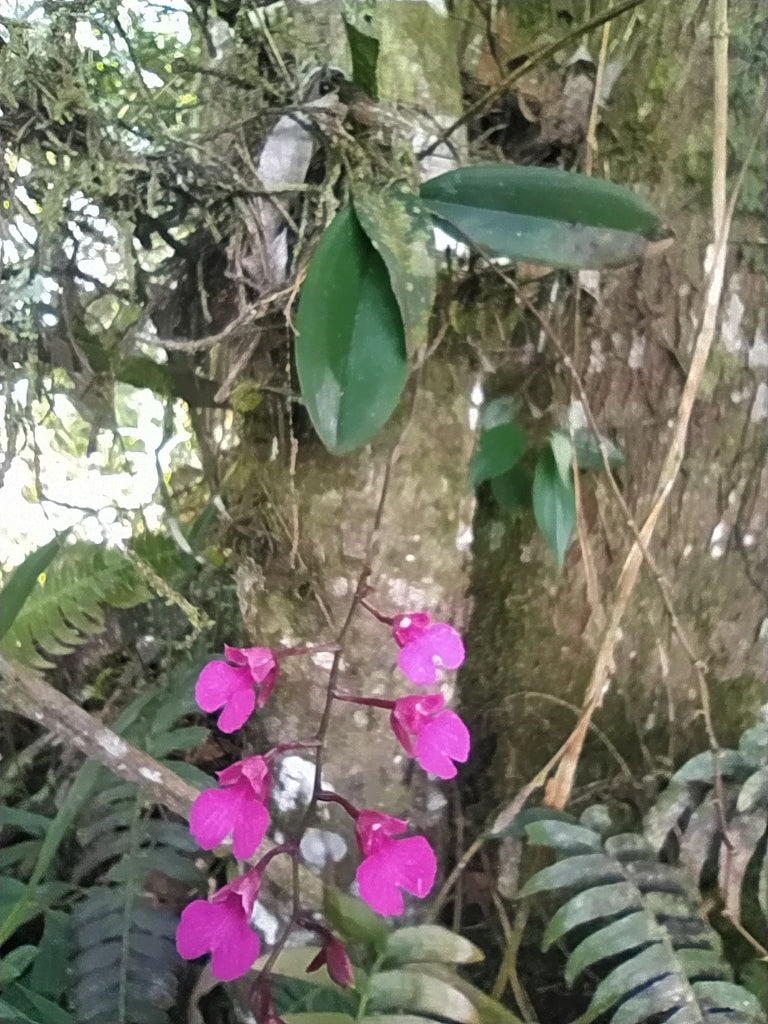
Comparettia falcata - species - miniature orchid
Comparettia falcata - species - miniature orchid
Regular price
$49.00 AUD
Regular price
Sale price
$49.00 AUD
Taxes included.
Shipping calculated at checkout.
Quantity
Couldn't load pickup availability
Comparettia falcata is an epiphytic orchid species native to tropical America.
Key Characteristics
Plant: A small, sympodial epiphyte (or occasional lithophyte) that can reach up to 20 cm in height. It features small, oblong-cylindric, slightly compressed pseudobulbs, 1-4 cm long. Each new growth has a single, leathery, elliptic to oblong-lanceolate leaf, typically 3-17 cm long. The common name "sickle-shaped" (falcata) refers to the leaf shape.
Flowers: The plant produces showy, deep pink (sometimes paler in the middle with darker veins) flowers, about 2.5 cm wide. The flowers appear on an arching or pendant inflorescence that can be over 30 cm long and bear up to 8 flowers.
Flowering Season: It typically blooms from late winter to early spring, through the summer.
Distribution: Comparettia falcata has a wide distribution, found in Mexico, Central America, the West Indies, and northern South America (including Colombia, Ecuador, Peru, Brazil, and Bolivia). It primarily grows on tree trunks and branches in wet montane forests at elevations of 200 to 3000 meters.
Cultivation and Care
Light: Requires bright, indirect, or filtered light. It should be protected from direct midday sun. Strong air movement is important.
Temperature: Prefers cool to warm conditions, with an ideal temperature range of 10-26°C.
Watering: Water the plant when the growing media is about to dry out, approximately two to three times a week during the active growing season. The plant should never be allowed to dry out completely. If mounted, water more often.
Substrate: It is often grown mounted on cork or tree fern slabs. If potted, it needs a loose, airy, well-draining mix such as fine bark and perlite.
Humidity: Thrives in high humidity levels of 80-85%.
Fertiliser: Use a balanced orchid fertiliser every two weeks during the growing season.
Tips for the Australian Climate: These plants truly come alive once temperatures drop at the end of summer and they experience a few consecutive rainy days. They thrive in cool, damp conditions; dry winds will dehydrate them rapidly. Ideally, they should be kept in an environment similar to a cool gully near a running creek, surrounded by ferns and dripping water. While they can survive hot summers if their roots are covered in moss and watered regularly, they truly flourish during the cool autumn months—provided they are kept moist. I wouldn’t recommend them for beginners, but if you have a greenhouse with a misting section, you should be successful. If you have ever traveled up and down the Andes slopes, you know how quickly can the temperature change. The higher elevations are quite foggy and cool.
Plants currently in production. You can register your interest by emailing us. Due to their size, they will only be offered as flowering size plants.
---
DBN - PO BOX 4312, North Rocks, NSW 2151, AU - designsbntr@gmail.com
WE ONLY SHIP WITHIN AUSTRALIA (NO NT, TAS & WA at this point)
Share